 Blog
Blog
Why Don’t Mobile Ad Networks Finance Their Own Customers?

In the gap they leave, a new private credit asset class has quietly formed.
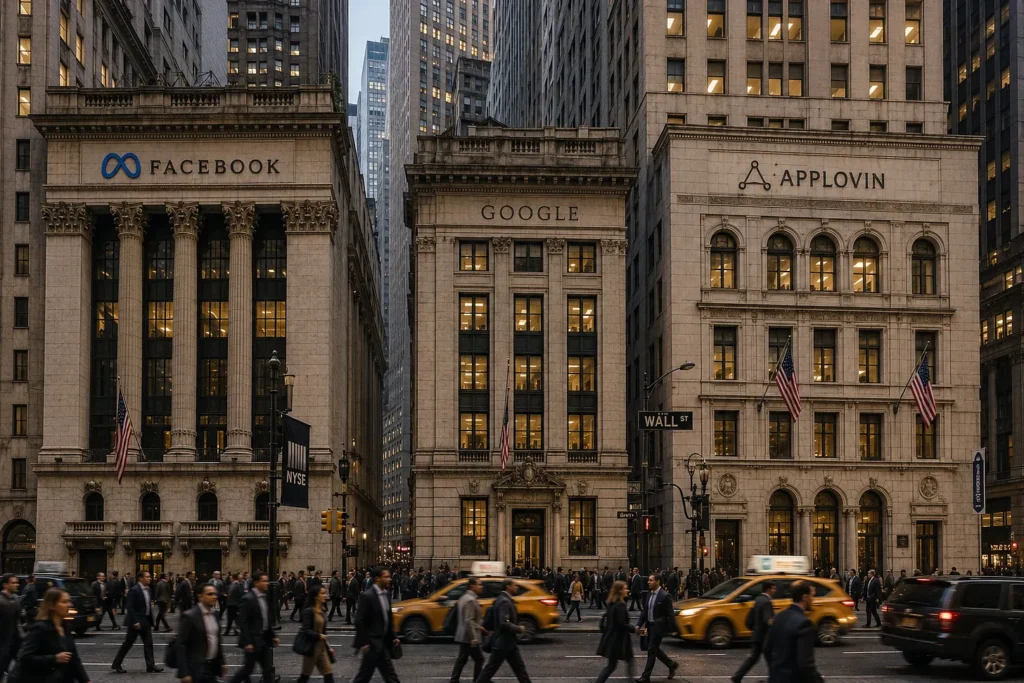
Some of the largest companies in America did not get that way just by selling their product. They got there by financing it. Caterpillar, John Deere and General Motors all built enormous businesses on the back of lending their own customers the money to buy what they were selling. Which raises a question that should bother anyone in mobile apps and gaming: the companies with the most to gain when a studio spends more on user acquisition are the ad networks themselves. So why don’t they fund it?
The mechanism all of those companies use is vendor finance, and the logic never changes. The manufacturer lends to its own buyer because it holds two things a bank does not: better information about whether that buyer can pay, and a strategic reason to want the sale that runs well beyond the return on the loan itself. A $400,000 excavator is far easier to sell when you also write the loan that pays for it. The loan of course is not really a loan in the traditional sense. It is a sales instrument with a coupon attached, and there have been long stretches when the finance arm out-earned the core business it was built to serve.
Hold that pattern against mobile user acquisition. The ad network sees the postbacks. It has insights into the predicted-LTV models that participate in the auction. It holds the richest real-time read on campaign performance available to anyone outside the studio itself. And it has the strongest strategic reason imaginable to want more spend: every incremental dollar of UA is its own revenue, at its own margin. No one is better positioned to finance a studio’s marketing than the network selling that studio its marketing.
And yet they don’t. The UA credit market has been built by cohort financiers, factoring companies and a handful of private credit funds who understand the payback curve and the unit economics at cohort level. Not by Meta, not by Google, not by AppLovin. This piece is about why they stay out, and about the asset class that has quietly grown up in the space they leave open.
The ad network is the natural lender. Up to a point…
Let’s start with data. Every lender in mobile is underwriting a forecast of return on ad spend, and the network holds the richest version of the inputs any external party can see: conversion signals, engagement proxies and benchmarks drawn from thousands of advertisers in near real time. That is a real and unusual edge. The network sees patterns across the market; it does not see a given studio’s blended ROAS across channels, its organic uplift, its true payer curves, its cash position or its balance-sheet stress. Post-ATT it increasingly infers downstream value rather than observing it, and a sophisticated studio often understands its own monetisation better than any network does. The advantage is breadth and timing, not depth on any single borrower, which is a distinction that matters later.
Then the unit economics, which are better than they first look. When a bank lends a million dollars it earns interest on a million dollars. When a network funds a million dollars of UA it earns the financing spread and the margin on a million dollars of inventory it has just sold to itself. The loan effectively pays twice, which puts its real break-even well below any third party’s. It could underwrite to total economics rather than to the credit alone, and still come out ahead.
Then there’s vendor lock-in. A studio with a credit line plumbed into its spend on one network finds it materially harder to move budget elsewhere. Working capital becomes a switching cost, and in a highly competitive market, that is the most durable retention mechanism an ad network could own.
On breadth of signal, embedded economics and lock-in, the network is the natural lender. The reasons it stays out lie elsewhere.
Payment terms run the wrong way
The closest the networks come to financing their customers is the payment term, and it runs the wrong way.
A studio spending on a network is typically billed Net 30. A large advertiser might occasionally negotiate a little more to win or hold an account, but anyone close to these conversations knows the institutional gravity pulls the other way: keep terms tight, bring collections in. Net 60 and 90, to whatever extent they were ever standard, have quietly shrunk.
Now set thirty days against the cash conversion cycle a games CFO actually plans around. A user acquired today does not start returning money quickly. For in-app purchase and in-app advertising revenue, the platform or mediation partner pays the studio on a lag of its own, as much as seventy-five days depending on the platform. Direct-to-consumer web payments are the exception, which is part of why they have become so strategically interesting, but for most studios most revenue still arrives late. Only once that first payout lands does the real payback curve begin, and it runs in instalments over the following months, often most of a year, before the cohort has returned what it cost to acquire.
So the studio pays cash out in thirty days, receives nothing for up to seventy-five, and is made whole only over the months that follow. Net 30 does not touch a duration problem where ROAS breakeven is measured in months. It moves the starting line by four weeks on a race that runs far longer. It is a billing convention wearing the costume of a concession.
Real UA financing has to be anchored to the payback curve: capital out for as long as the cohort takes to return it, repaid as that cohort actually pays back. A thirty-day invoice term is the opposite instinct, an entity pulling its own receivables in, not solving its customer’s working-capital problem. The networks are not edging toward vendor finance. Their corporate gravity pulls away from it.
Why ad networks stay out
The case is strong enough that the absence is a decision, not an oversight, and the simplest part of that decision is the easiest to overlook: the status quo is already close to perfect for them. Networks are paid in cash, now, with no credit risk, no provisioning, no collections and no workout, and they capture the full upside of a studio spending more the moment it spends. A lender takes duration risk to earn a spread. The network already earns more than that spread, in advance, for none of the risk. You do not reach for a financing return when you bank the whole economic return up front and clean. That, more than anything, explains the inertia.
Four structural reasons keep it that way. The first is regulatory: the moment a network lends it looks like a financial institution, which means licensing, capital treatment, credit and collections regulation, and regulatory attention, at precisely the moment the majors want less surface area, not more. Big Tech has reached into finance repeatedly and withdrawn every time.
The second is the conflict at the centre of the auction. The network runs the marketplace that sets the borrower’s return on ad spend; holding credit exposure to that borrower gives it a position in the outcome of its own auction. It need not act on it for the perception alone to be ruinous, because auction neutrality is its most valuable asset. It cannot be both the house that runs the table and a creditor betting on the players at it.
The third is correlation. Every borrower’s ability to repay turns on UA performance, which turns on the same platform, privacy and macro factors that drive the network’s own revenue. A privacy change or a softening in monetisation hits the core business and the loan book together, in the same direction. It is a leveraged bet on the one factor to which the company is already maximally exposed.
The fourth turns the information advantage on its head, in two layers. The studios with genuinely strong unit economics raise equity or cheaper debt elsewhere and will not pay network-priced credit; the ones who come asking skew toward the marginal. And the best operators go further, deliberately diversifying channels, limiting platform concentration and guarding their data, precisely to avoid the dependency network-tied financing would create. The demand that would actually present itself is adversely selected twice over, and the network’s data tells it exactly that.
Each is real. What they share is more telling: every one is an objection to the network holding the risk; none is an objection to it owning the funnel. That distinction is the whole game, and one company up the coast has already worked it out.
Didn’t Amazon already solve this?
The closest thing in technology to an ad network is Amazon: a marketplace that sells advertising into itself and holds proprietary data on how much its customers actually sell. It faced these objections in their purest form, and what it did about them is the most useful precedent here.
Amazon began by doing the obvious thing, lending its own money to sellers, invitation-only, off its own sales data. The instructive part is that it stopped. It has spent the years since moving the balance sheet off its own books and rebuilding the programme as something else. Today, Amazon Lending delivers financing through third-party providers rather than from Amazon itself, across a curated panel including Uncapped, the merchant cash advance provider Parafin, and Slope, whose credit line is backed by a J.P. Morgan facility. The mechanism is the point: sellers are shown financing invitations inside Seller Central and, on applying, must agree to share their Amazon selling data with the provider before being handed off to complete the application. Amazon supplies the data and the funnel; the provider supplies the balance sheet and carries the loss.

Map that onto the reasons to stay out. Amazon kept the data, the demand stimulation and the relationship, and shed the licensing, the capital treatment, the correlated book and the collections role. It even resolves the adverse-selection problem, in the most elegant way available: its information advantage is expressed not as underwriting but as the right to pre-qualify and invite. It screens the funnel with data no competitor can see, then hands a pre-selected book to lenders who price it and own the risk. The best-informed party does not place the bet; it decides who is offered one. The lemons problem is defused at the gate, which is precisely why a breadth-not-depth signal is enough.
And the financing need not be neutral as to where it is spent: Amazon lists purchasing ads and expanding marketing among the permitted uses. The nearest analogue to an ad network is already running platform-orchestrated credit that loops back into its own ad business, dressed as seller working capital. The objection was never that this cannot be done. It was only ever that the platform should not be the one holding the risk.
The move nobody makes
It would make even more sense for a mobile ad network than it did for Amazon. The network already runs the models, already owns the console where budgets are set, and could surface invitations and hand a screened book to a panel without inventing anything. Amazon has already drawn the diagram.
What keeps it undone, beyond the inertia, is the one objection intermediation does not fully clear. When Amazon finances a seller, the money buys inventory and the link back to Amazon’s revenue is indirect. When a network arranges credit, the money is spent on ads, which is the network’s own top line. Helping arrange financing that can really only be spent with you is a sharper optic than helping fund inventory, and no third-party structuring entirely removes it. The most logical move in the market stays the one nobody makes.
So the work has fallen elsewhere, and the more interesting story is what that produced. It did not fall to banks: a bank underwrites traditional collateral, and there is none here, only a probabilistic cohort curve that self-liquidates over months and has to be read rather than secured. It fell instead to a small set of specialist lenders, and in doing so something quietly happened that is easy to miss. UA credit became an asset class. Not long ago this was effectively uninvestable: measurement was too poor, repayment too uncertain, the underwriting impossible for anyone without operator instinct. The maturation of cohort analytics and attribution changed that, and probabilistic repayment became something a disciplined lender could price. A genuinely new private credit category formed, in the space the best-informed players declined to occupy.
Which is where the picture settles. The companies with the most to gain when a studio spends more, the clearest external read on whether it will, and a finished blueprint one industry over, still leave the financing of their own customers to other people. The blueprint is drawn, the data is theirs, the door is open. They just keep not walking through it. 🤷♂️

Mobile Finance Collective is a pioneering community which brings together finance leads and founders of mobile app and gaming studios to share knowledge and build connections. We are supported by top tier industry mentors, and provide an environment where we can all learn from each other, helping to grow your business and enhance your career.